Key Specifications
 Prime Delivery • 30-Day Returns
Creality K1 SE 3D Printer, 600mm/s High-Speed Hands-Free Auto Leveling Flagship-Level Direct Extruder Quick-swap Tri-Metal Nozzle K1 Upgrade 3D Printer, Print Size 250x220x220mm
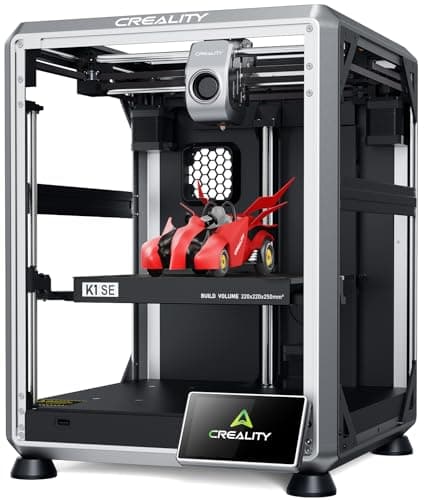
The Creality K1 SE is a desktop FDM-style 3D printer built for speed and convenience. It uses a lightweight CoreXY motion system, can reach up to 600 mm/s print speed with very high acceleration, and promises features like automatic bed leveling and a quick-swap tri-metal nozzle. It’s positioned as a “plug-and-play” printer — pre-assembled, pre-tuned, so that after unboxing it should take minimal effort to start printing.
Key Features
The Creality K1 SE is a desktop FDM-style 3D printer built for speed and convenience. It uses a lightweight CoreXY motion system, can reach up to 600 mm/s print speed with very high acceleration, and promises features like automatic bed leveling and a quick-swap tri-metal nozzle. It’s positioned as a “plug-and-play” printer — pre-assembled, pre-tuned, so that after unboxing it should take minimal effort to start printing.
Available Colors
Key Considerations
Print speed vs. quality — High travel/print speed (600 mm/s) is a big advantage for speed, but you should consider whether that speed will affect print precision for your use.
Build volume — With a print size up to 250×220×220 mm, assess whether it suits the size of the models you plan to print.
Material compatibility & extruder design — The printer’s direct extruder and durable tri-metal nozzle (plus good hotend) claims to support a range of filaments, perhaps including flexible ones like TPU.
Ease of use / setup convenience — Auto-calibration, pre-assembly, quick nozzle swap, filament sensor (for run-out detection) and other automated features could make it much easier to use, especially for beginners or for those who want simplified workflow.
Frame stability & vibration control — Because of high speeds, stable motion and minimized vibration are important for print quality. The printer advertises an aluminum-alloy / die-cast frame plus anti-vibration cooling fan + input shaping algorithm for better stability.
The K1 SE uses a CoreXY kinematic system, which enables faster and more efficient motion compared to many Cartesian printers — allowing it to reach up to 600 mm/s with high acceleration (up to 20,000 mm/s²). This makes the printer ideal if you care about quick turnaround time, producing multiple parts fast, or printing larger models in less time. However, faster printing can risk reduced detail or more artifacts — so balancing speed vs quality through proper settings is necessary.
These factors represent the most critical aspects that will impact your satisfaction with this product.
Customer Reviews
Arrival and assembly: As a first time 3D printer novice I was pleasantly surprised at how well the printer was packaged.
Fast and easy to setup and use. Even the steps needed to use fluidd/mainsail are easy to execute and update. It is very much a remove from box, turn on (wait for calibration) and use. The PC and mobile software is really easy and convenient to use, while I heavily recommend getting the $20 AI camera that is available.