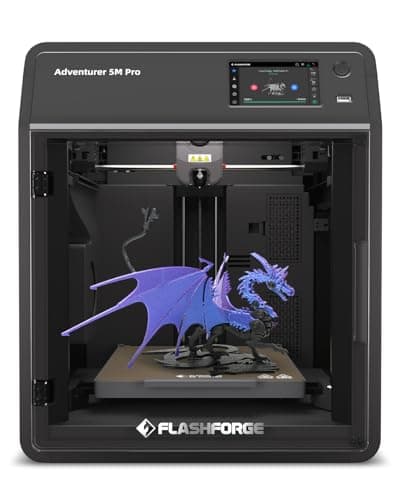
Key Specifications
 Prime Delivery • 30-Day Returns
FLASHFORGE AD5M Pro 3D Printer, CoreXY 600 mm/s Printing Speed, 0.4 & 0.6mm 3s Quick-Swap 280°C Nozzles, 1-Click Auto Leveling, Fully Enclosed, 220×220×220mm Build Volume
The Ender-3 S1 is a mainstream desktop FDM (Fused Deposition Modeling) 3D printer positioned by its manufacturer as a “next-step up” from entry-level machines. It combines ease of use (relatively simple assembly and auto-leveling) with enhanced printing capabilities: direct-drive extrusion (via “Sprite” dual-gear extruder), a print bed with spring-steel sheet, filament sensor, resume-print after power loss, and a silent 32-bit mainboard — making it suitable for both beginners and hobbyists who want reliable prints with a variety of common filaments.
Key Features
The Ender-3 S1 is a mainstream desktop FDM (Fused Deposition Modeling) 3D printer positioned by its manufacturer as a “next-step up” from entry-level machines. It combines ease of use (relatively simple assembly and auto-leveling) with enhanced printing capabilities: direct-drive extrusion (via “Sprite” dual-gear extruder), a print bed with spring-steel sheet, filament sensor, resume-print after power loss, and a silent 32-bit mainboard — making it suitable for both beginners and hobbyists who want reliable prints with a variety of common filaments.
Available Colors
Key Considerations
Print Volume & Project Size: Its build volume of 220 × 220 × 270 mm is standard for many desktop printers — suitable for small- to medium-sized models, prototypes, and parts.
Material Compatibility: Supports common materials like PLA, PETG, TPU, ABS. Its direct-drive extruder (good for flexible filaments like TPU) and heated bed help broaden printing possibilities.
Ease of Use & Setup: The printer ships semi-assembled, with relatively straightforward setup (some screwing + plugging). The auto-bed leveling (CR Touch) helps simplify initial calibration.
Print Precision & Reliability: With a dual-gear extruder for smooth filament feeding, a dual Z-axis setup for stability, and a silent 32-bit mainboard, the S1 aims to deliver stable, accurate prints with minimal noise.
Limitations on Advanced Materials: Because the hotend on the standard S1 is not “all-metal” (it uses a PTFE-lined hotend), nozzle temperature is capped (around 260 – 260–260–260? sources show 260 °C max), which limits printing of very high-temp filaments (e.g. some nylons or composites).
The S1 uses Creality’s “Sprite” direct-drive extruder, which offers firm, consistent filament feeding and works well with flexible materials like TPU, along with standard filaments (PLA, PETG, ABS, etc.). This makes it more versatile than many older Bowden-tube printers.
These factors represent the most critical aspects that will impact your satisfaction with this product.
Customer Reviews
This is my first 3D printer and let met tell you, I am absolutely blown away. I got great results on my first test print. Since then I've printed several things and needed to make minor adjustments but this product allows for easy adjustment and fine-tuning.
Zusammengebaut ist das Gerät in wenigen Minuten, Die Verkabelung könnte ein wenig besser beschriftet sein. Aber ein Blick in den Quickstart hat auch hier schnell geholfen.