Key Specifications
 Prime Delivery • 30-Day Returns
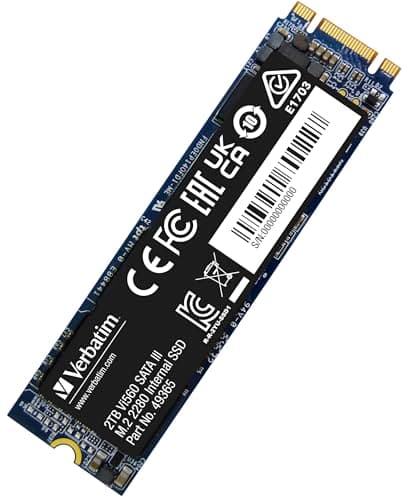
Verbatim 2TB SSD Vi560 Internal Solid State Hard Drive 3D NAND SATA III M.2 2280
The Verbatim Vi560 SSD leverages modern 3D NAND flash technology and a standard SATA III M.2 2280 interface to deliver a substantial performance upgrade over traditional hard drives. With read speeds up to ~550–560 MB/s and write speeds up to ~500–520 MB/s depending on capacity, the Vi560 dramatically reduces system boot times, accelerates application launch, and boosts overall system responsiveness.
Key Features
The Verbatim Vi560 SSD leverages modern 3D NAND flash technology and a standard SATA III M.2 2280 interface to deliver a substantial performance upgrade over traditional hard drives. With read speeds up to ~550–560 MB/s and write speeds up to ~500–520 MB/s depending on capacity, the Vi560 dramatically reduces system boot times, accelerates application launch, and boosts overall system responsiveness.
Available Colors
Key Considerations
Interface & Form Factor — Whether the SSD fits physically and electrically into your system (e.g. M.2 2280 SATA, or PCIe/NVMe) affects compatibility and performance.
Read/Write Speed (Sequential + Random I/O) — Determines how fast your OS boots, applications load, and large files transfer. For general use, sequential speeds matter; for OS and many small-file operations, random I/O (4 KB) performance matters.
Flash Type & Controller Design — 3D NAND, wear-leveling, and controller architecture influence longevity, reliability, and speed stability over time.
Power Consumption & Thermal Behavior — Important especially for laptops: lower power draw can increase battery life; good thermal design avoids overheating and throttling.
Durability and Shock/Vibration Resistance — SSDs have no moving parts, but build quality and flash management affect how well they handle physical shocks, vibrations, or frequent mobility.
Vi560 offers ~ 550–560 MB/s read and ~ 500–520 MB/s write (depending on model) thanks to SATA III and 3D NAND. This results in significantly faster boot times, quicker application launch, and more responsive system performance compared to mechanical HDDs.This performance is more than enough for OS operations, office tasks, web browsing, moderate gaming, and media storage.
These factors represent the most critical aspects that will impact your satisfaction with this product.
Customer Reviews
One screw to remove the bottom of the laptop and one screw to install the M.2 drive. Cloned the existing spinning hard drive and switched the boot drive in the BIOS to the SSD. The new drive became C: and the old one became D:. Been running Windows 10 for several days without issue.
It's a solid state drive - it stores and retrieves data, and does so pretty quickly.